










Did you know? Fun Facts
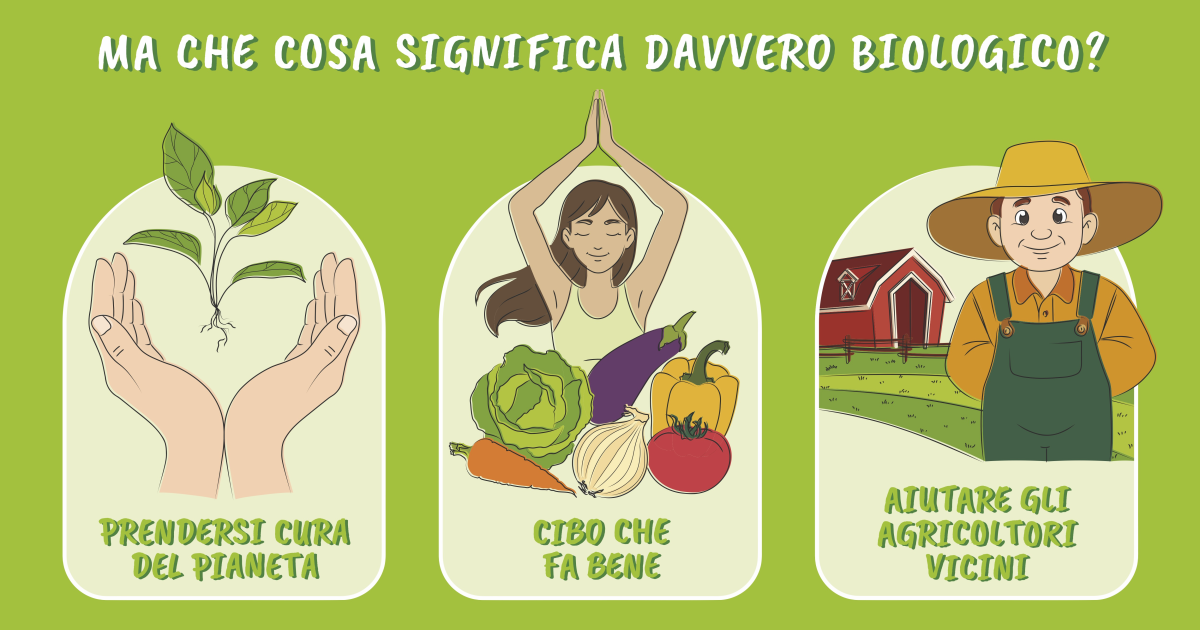
What Does “Organic” Really Mean?
The concept of organic farming, as we understand it today, is relatively recent, having developed during the 20th century mainly in Europe and the United States. It was only from the 1960s onwards that it became more established and began to spread across all continents (1).
Despite the steady growth of organic farming over the past decades, there is still often confusion about what it actually means to grow, and above all to consume, organic products. In everyday life, when we go grocery shopping, we often walk past the organic section without stopping to consider why these products cost more or why they are considered healthier. At first glance, most people think that organic farming is a form of agriculture that seeks to minimise the use of synthetic chemicals (such as most pesticides, herbicides, fungicides and soluble mineral fertilisers) in order to obtain higher-quality products, resulting in healthier food for consumers. While all of this is true, the concept of organic farming is much more complex than that, and here we will try to explain it more clearly.
Organic agriculture is an agricultural production system whose fundamental principle is the protection of the environment and the health of the soil, plants, animals and people, through the use of natural or sustainable practices, minimising, as mentioned above, or completely eliminating the use of synthetic inputs (chemical fertilisers, synthetic pesticides, genetically modified organisms, etc.). According to data published in the latest edition of The World of Organic Agriculture 2025, published by the Research Institute of Organic Agriculture FiBL, one of the world’s leading research institutes in the field of organic agriculture, in 2023 the area of land cultivated through organic farming amounted to 98.9 million hectares (+2.5 million hectares compared with 2022), confirming the continued global growth of this sector over recent decades (2).
If you are wondering what 98.9 million hectares actually means, for simplicity we can say that this is equivalent to approximately three times the total area of Italy. And yet, it represents only 2.1% of the world’s agricultural land (the total agricultural area is 4.7 billion hectares, according to FAO data) (14).
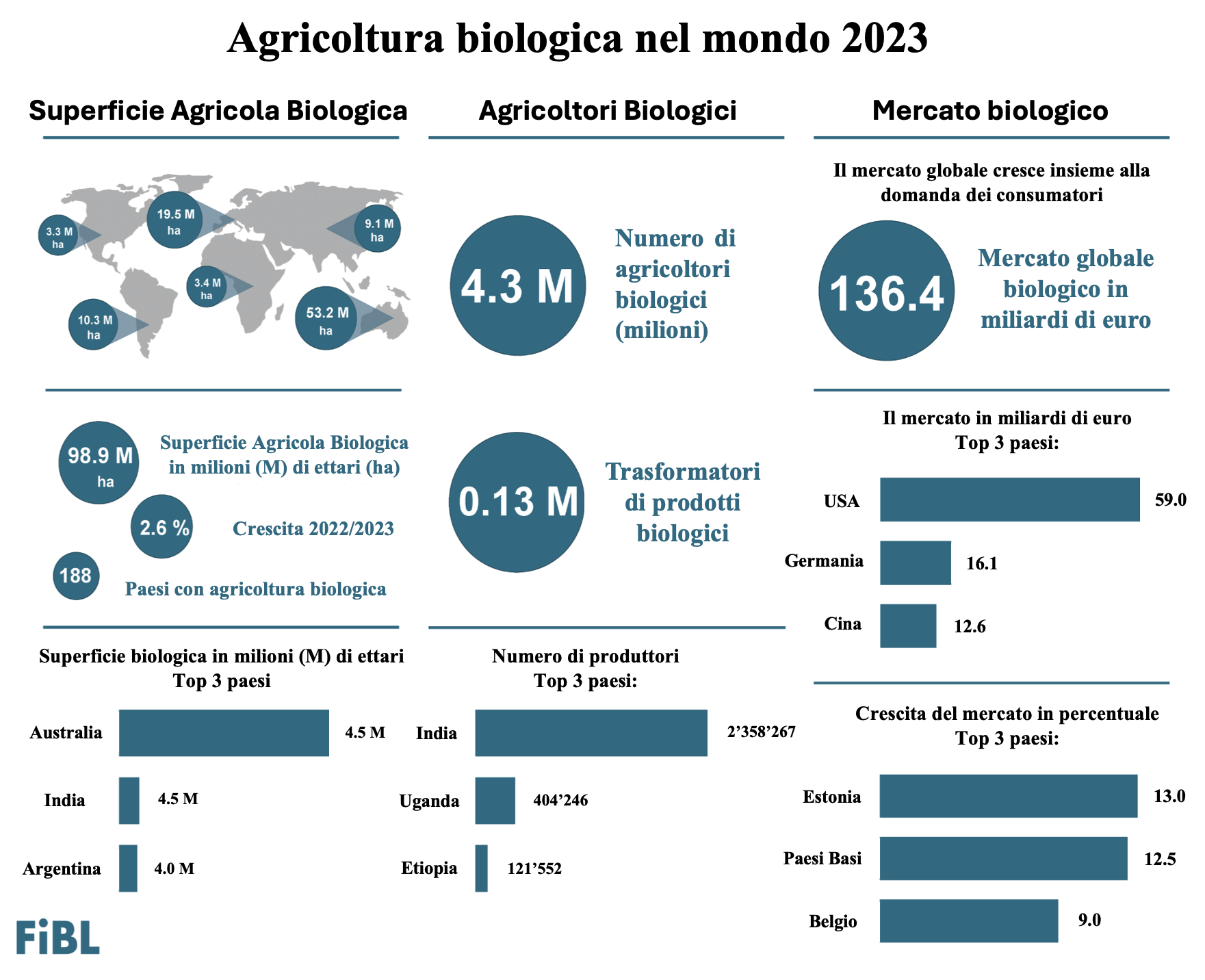
Figure 1 – Some information on organic farming. Amount of organically farmed land on each continent in 2023. Europe accounted for 19.5 million hectares of organically farmed land in 2023. The global organic market is worth €136.4 billion, with 4.3 million organic farmers. Australia is the country with the largest area of organically farmed land (53 million hectares), followed by India (4.5 million hectares) and Argentina (4 million hectares). Image taken and adapted from FiBL (2).
Leaving aside the technical and more complex details, one of the questions we should ask ourselves is: how could consuming organic products improve our lives?
There are three main reasons worth considering. The first, without a doubt, concerns the prevention of health problems. One of the major changes in the medical field over recent decades has been the growing focus on prevention. Prevention is always better than cure, including from an economic perspective: in the long term, the national healthcare system saves more by investing in prevention rather than treatment, which remains very costly (3). In recent years, a growing body of evidence from observational studies has indicated potential health benefits associated with the consumption of organic foods (4). Such consumption may contribute to the prevention of various diet-related conditions, including allergies and intolerances (5). Some studies have also suggested a possible protective effect against certain types of cancer (6) (7) (8); however, it is essential to consider the overall lifestyle context and the need for further research to definitively confirm these effects.
When it comes to organic products, there are no major differences in terms of macronutrients (proteins, fats, carbohydrates and fibre) compared with conventional products. However, some micronutrients do differ, including higher concentrations of antioxidants (particularly polyphenols) in organically grown crops; higher levels of omega-3 fatty acids in organic dairy products; and improved lipid profiles in organic meat (9) (10) (11). Perhaps more significant than these compositional differences is what is not present in organic products. Studies have shown that these foods contain lower levels of toxic substances, including heavy metals such as cadmium, as well as residues of fertilisers and synthetic pesticides (12). In addition, consuming organic products may help reduce exposure to antibiotic-resistant bacteria (13). Therefore, eating organic foods may contribute, among other things, to the prevention of various diseases, particularly when combined with a healthy lifestyle.
The second reason why choosing organic products is important concerns environmental protection and our contribution to environmental sustainability. In nature, every organism and every element of an ecosystem is part of a complex and highly integrated system, in which ecological balance depends on the interactions between different species and their environment. Every component—plants, insects, fungi, microorganisms and others—plays an essential role in maintaining the stability and resilience of the ecosystem. Conventional agriculture, through the intensive use of chemical fertilisers, pesticides and herbicides, tends to favour cultivated species almost exclusively, disrupting natural balances. These practices reduce biodiversity by indiscriminately eliminating wild plant species, insects and beneficial microorganisms. The resulting loss of biodiversity leads to the biological impoverishment of the soil and surrounding environment, reducing the natural system’s ability to regenerate itself and withstand environmental stresses. This impoverishment can have serious long-term ecological consequences, compromising the sustainability of both agricultural and natural ecosystems.
Organic farming seeks to minimise as far as possible any potential damage that could be caused to the ecosystem, striving to protect every single element. To this end, the soil is cultivated as little as possible, while the use of synthetic substances is permitted mainly when there is no viable alternative. Clearly, all of this is carried out in compliance with current legislation and with national and European organic farming regulations.
Organic farming is an integrated system that aims to reconcile food production with environmental protection. It is based on practices capable of meeting human needs for food and fibre in the long term, while simultaneously improving environmental quality and optimising the use of non-renewable resources. A fundamental example is crop rotation, which consists of alternating crops on the same piece of land rather than repeatedly growing the same plant species. This method prevents the soil’s nutritional balance from becoming disrupted by avoiding the continuous depletion of the same nutrients. For example, growing a cereal one year, a legume the following year and another cereal the year after that reduces the excessive depletion of the soil. Leguminous plants also help enrich the soil with nitrogen, an essential element for life, thereby improving the natural fertility of the land. In this way, a complex system is created in which the soil is naturally enriched, while at the same time biodiversity increases and local consumers have greater choice when it comes to a more balanced, locally produced diet.
Therefore, unlike conventional methods, which depend on human intervention to force agricultural systems in particular directions, sustainable agriculture harnesses natural processes and available renewable resources to ensure long-term production. In essence, it is a management approach that works in harmony with nature to conserve resources, minimise environmental impact and ensure continuous production that nourishes and benefits both farmers and society as a whole.
The third reason concerns personal well-being and the well-being of the area in which we live. In most cases, organic products offer a more authentic and appealing flavour, stimulating the senses more intensely during a meal. But the benefit is not only about taste: choosing organic also means supporting the local economy, helping small farms that often take significant risks to grow and preserve varieties and food species that conventional industry would not be able to maintain. In this way, alongside nourishing our bodies, we also contribute to protecting biodiversity and strengthening the community in which we live.
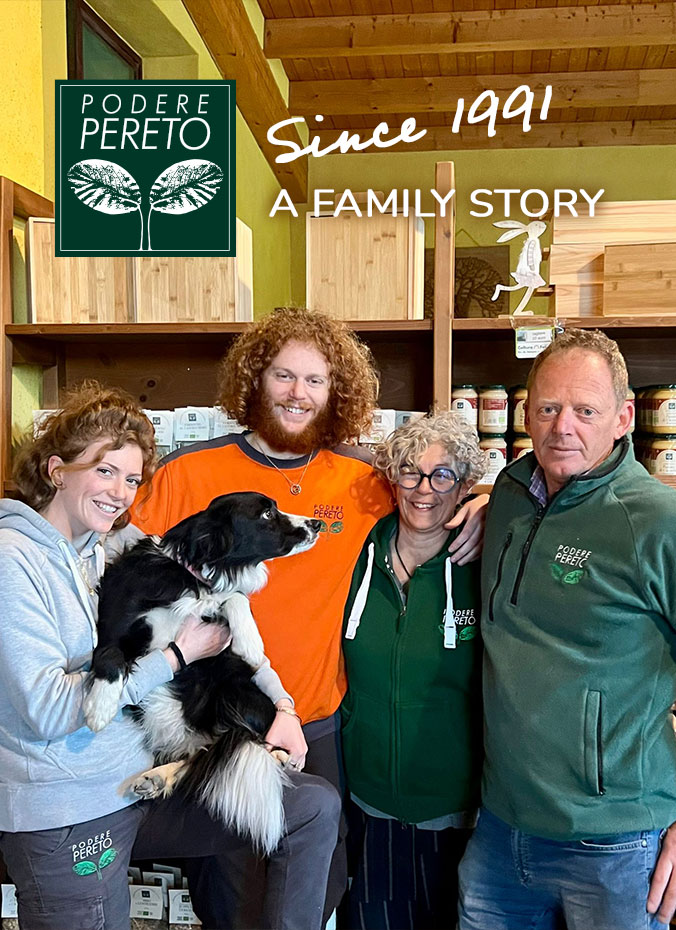
Our farm is one example. Since its foundation, Podere Pereto has consistently committed itself to growing varieties of cereals and legumes that, without initiatives of this kind, could risk disappearing or gradually being abandoned. Among the rare and local varieties that Podere Pereto has worked to recover and cultivate are Ancient Grains, including Sieve, Verna, Gentil Rosso, Frassineto and Andriolo, as well as durum wheat varieties such as Turanicum and Cappelli, which tend to be more widespread and better known. As for legumes, particular mention should be made of the Zolfino bean from Pratomagno, the Toscanello bean and the small chickpea from Valdarno.
The recovery of these seeds, and the demanding work involved in preserving and cultivating them so that they can reach consumers’ tables, would not be economically sustainable without the premium we pay whenever we walk past the organic section of the shops where we do our grocery shopping.
In conclusion, consuming organic products means more than simply choosing what we put on our plate. It is an act that embraces the land, safeguarding the richness of biodiversity and protecting the soil so that agriculture can remain healthy and sustainable over time. It means taking care of ourselves, nourishing our bodies with attention and caring for our health through prevention. But it is also an act of connection with the local area—a concrete way of supporting farmers and businesses that turn this choice into a philosophy of life, helping to create a fairer, cleaner and more authentic world, while preserving it for the future.
Bibliografia
1. Johansson, E., Hussain, A., Kuktaite, R., Andersson, S. & Olsson, M. Contribution of Organically Grown Crops to Human Health. Int. J. Environ. Res. Public. Health 11, 3870–3893 (2014).
2. Willer, H., Travnicek, J. & Schlatter, B. The World of Organic Agriculture. Statistics and emerging trends 2025.
3. Ministero della salute italiano. Allegato 3 Piano nazionale prevenzione, 2020- 2025.
4. Vigar, V. et al. A Systematic Review of Organic Versus Conventional Food Consumption: Is There a Measurable Benefit on Human Health? Nutrients 12, 7 (2019).
5. Pernin‐Schneider, M. et al. Organic Food Consumption Might Protect Against Sensitisation to Inhalant Allergens at School Age: The PARIS Cohort. Allergy 80, 258–270 (2025).
6. Baudry, J. et al. Association of Frequency of Organic Food Consumption With Cancer Risk: Findings From the NutriNet-Santé Prospective Cohort Study. JAMA Intern. Med. 178, 1597 (2018).
7. The Million Women Study Collaborators et al. Organic food consumption and the incidence of cancer in a large prospective study of women in the United Kingdom. Br. J. Cancer 110, 2321–2326 (2014).
8. Rahman, A. et al. A Comprehensive Analysis of Organic Food: Evaluating Nutritional Value and Impact on Human Health. Foods 13, 208 (2024).
9. Barański, M. et al. Higher antioxidant and lower cadmium concentrations and lower incidence of pesticide residues in organically grown crops: a systematic literature review and meta-analyses. Br. J. Nutr. 112, 794–811 (2014).
10. Benbrook, C. M., Butler, G., Latif, M. A., Leifert, C. & Davis, D. R. Organic Production Enhances Milk Nutritional Quality by Shifting Fatty Acid Composition: A United States–Wide, 18-Month Study. PLoS ONE 8, e82429 (2013).
11. Średnicka-Tober, D. et al. Composition differences between organic and conventional meat: a systematic literature review and meta-analysis. Br. J. Nutr. 115, 994–1011 (2016).
12. Brantsæter, A. L., Ydersbond, T. A., Hoppin, J. A., Haugen, M. & Meltzer, H. M. Organic Food in the Diet: Exposure and Health Implications. Annu. Rev. Public Health 38, 295–313 (2017).
13. Smith-Spangler, C. et al. Are Organic Foods Safer or Healthier Than Conventional Alternatives?: A Systematic Review. Ann. Intern. Med. 157, 348–366 (2012).
14. Food and Agriculture Organization of the United Nations (FAO). FAO – Food and Agriculture Organization of the United Nations